
( Acts 2, 1-13 ) - [ Deutsch ] - [ Akündigungen444.11 KB ]
Dear congregation, today we celebrate the feast of Pentecost, the outpouring of the Holy Spirit. In doing so, we bring with us very different experiences. One of us might come to the service today with gratitude because he has already experienced much of God's Spirit in his life. Another comes with the expectation that the Holy Spirit will finally touch them personally. Another comes with the question of where the breath of the Spirit can be felt at all.
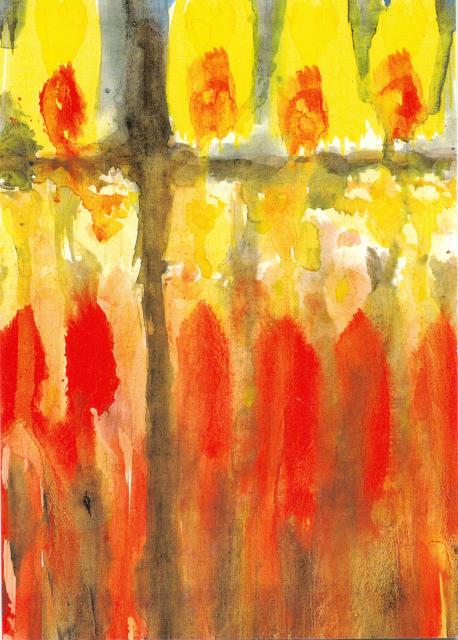
I would like to pursue this question with the help of an image. When I look at the picture, I first see only colourful blobs of colour: Yellow - Orange - Red. A strong dark stripe goes vertically through the picture. This is crossed by a corresponding horizontal stripe the upper part of the picture. One can recognize a cross in it. "Give us your spirit" Manfred Boiting calls his drawn with watercolour picture.
The title helps us to get closer to the content of the picture. The yellow colour above the black horizontal stripe makes me think of light that surrounds the red flames. One could think here of the tongues of fire that our Bible text in Acts speaks of.
3 They saw what seemed to be tongues of fire that separated and came to rest on each of them.
Below the black bar there are vertical red brush strokes, above which circles are drawn in pencil. They shimmer faintly under the yellow paint. I think I can recognize figures with flames falling from above. Their bodies are painted a strong red. It seems as if in them a fire ember has been kindled in them. It is as if these people are glowing from within. "To be on fire for something", I have to think of this proverb here.
Fire and flame - both terms trigger certain ideas in me. In my mind I think of a big fire, with the flames flying high, flickering. I think of words that ignite, kindle, ignite, glow. I see a fire in the fireplace, like every evening at the moment in the rectory. Fire is fascinating to look into. And fire is also dangerous. A small spark is enough to start a big fire.
The story of Pentecost ties in with this idea. Here it is described how people become “fire and flame“ for Christ. The spark makes them glow, it turns them into people who are enthusiastic, who are inspired, he makes them "spirit-moved".
Luke's Acts of the Apostles describes how all hopelessness and fear fell away from them. The Spirit of God has passed on to the disciples. They rise, they stand up. The despondent crowd become the apostles who carry the gospel, the good news, into the world. What was the content of their speech?
Peter proclaims Jesus, who was crucified to save us from judgment, who was raised to give us new life in the Holy Spirit. The disciples are full of enthusiasm what they have experienced with this Jesus and what God wants. Some who listen suddenly realize: this is not a boring story.
What they are talking about concerns us! The stories of Jesus are stories of life, of eternal life. People understand what the disciples are saying. Language is no longer an obstacle. What happens here is the birth of the church of Jesus Christ.
But not all the listeners are so enthusiastic about the disciples' message. Some react with dismay, horror, amazement or perplexity, some even with mockery. Some of the listeners mistake the enthusiasm emanating from the disciples for drunkenness. But the disciples speak clearly. Our collage today as a reading reflects that the event of Pentecost is often contrasted with the Old Testament story of the Tower of Babel. At that time, people no longer understood each other. It was not just that they no longer understood each other's language, they no longer understood what each other meant and felt. Everyone was preoccupied with himself, with his own well-being.
The Tower of Babel is a prehistoric example of how a community breaks up when there is no effort to understand the other. Everyone then goes his own way and common projects are no longer possible.
In the Acts of the Apostles (Acts 2:46) it says: "They were together daily with one accord, they had a common goal. Each one took the other into consideration, they talked with each other again and no longer about each other or past each other. This is also the case today in a community: Where there is understanding among each other, it flourishes. And isn't that what we all want? That our community flourishes?
That is not just an ideal, but something we experience in our community. For 30 years now, people have been working here and are still doing so. We work together in many different areas to make our community a place where everyone feels welcome. There is always something to do. The community is never finished. It is always a process. The spirit blows where it wants. And when it blows, music resounds to praise God together. Then people come together to worship, big and small. And people will be comforted. And I could say much more about this.
Let's now also take a look at the dark bars that cross each other in the picture. It is connected with the memory of the death of Jesus, which was failure and fulfilment in one, fulfilment of an infinite love, which is stronger than death. Thus, the cross is a sign of hope that points beyond death to life.
The artist has painted yellow flames above and below the horizontal bar. I think he wants to show that the spirit of Jesus Christ passes over to the people standing under the cross. We too, like them, can be caught up in God's Spirit. "Spirit-moved" people live from the power that comes from the cross of Jesus Christ.
The blowing of the Spirit can be felt in many ways - by those who believe.
People who are seized by the glow of God's Spirit are completely immersed in bright red in our picture. The colour red stands for love. The red figures in our Pentecost picture show me: filled with God's love, people are driven to enthusiastically share God's good news with the world.
We belong to this flock of the "Spirit-moved". Amen